Have a project for us?
DO YOU HAVE ANY QUESTIONS REGARDING YOUR NEXT CONSTRUCTION PROJECT?
Published on: May 29, 2026
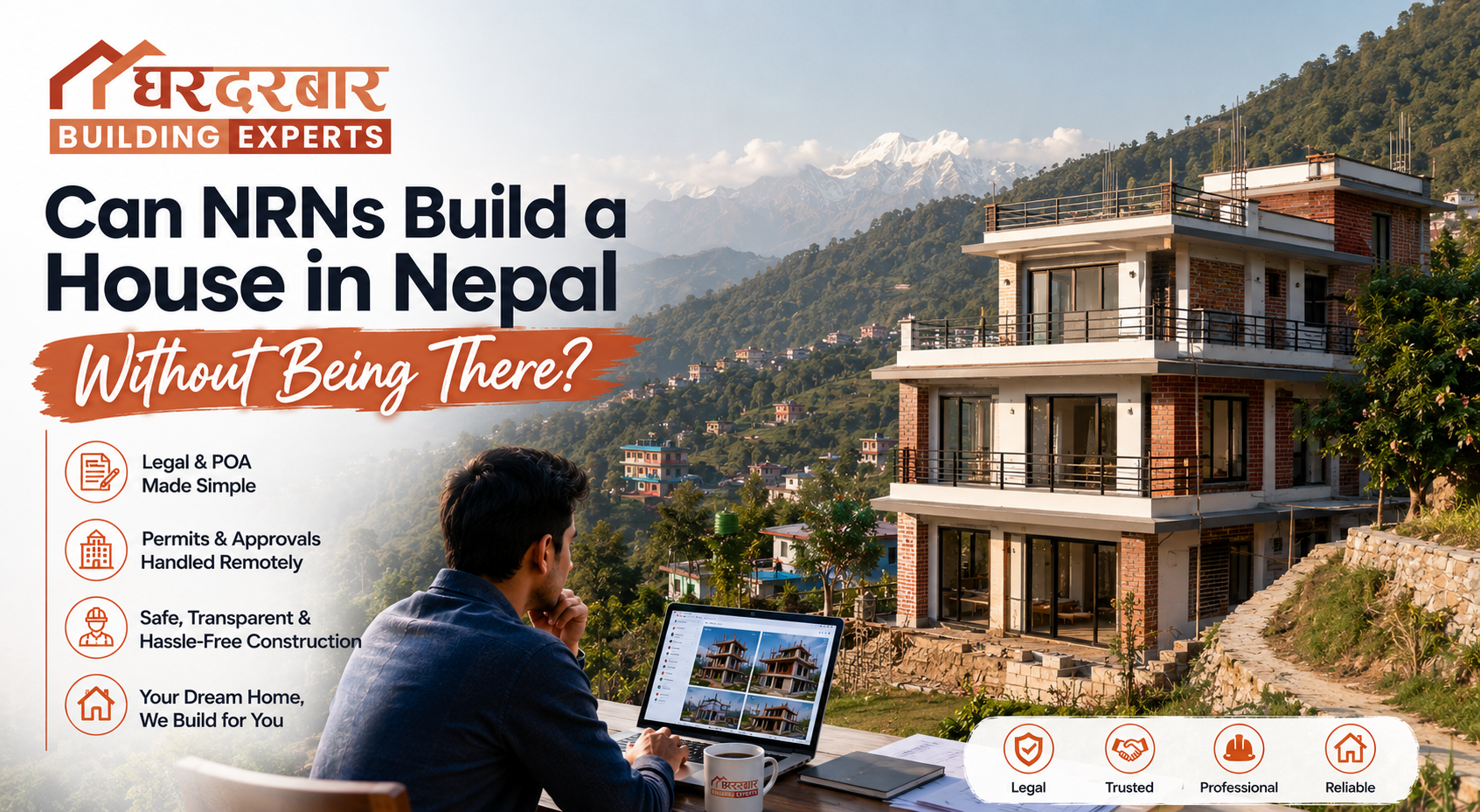
If you are a Nepali living abroad, there is a good chance that building a house back home has crossed your mind more than once. Maybe your parents are getting older and you want to give them a proper home. Maybe you have been sending remittances for years and finally want something solid and permanent to show for it. Or maybe you simply miss home and want a place to return to someday. Whatever the reason, the dream is real and very common among Non-Resident Nepalis.
But the moment you start thinking practically, the doubts come in. You are in Australia, the US, the UK, Japan, or the Gulf. You cannot just take six months off and fly back to supervise construction. So the big question becomes: can you actually build a house in Nepal without physically being there?
The short answer is yes, you can. But like most things in life, the longer answer comes with important details you need to understand first.
Before getting into the construction side, it helps to be clear on what the law means by NRN. Under the Non-Resident Nepali Act of 2008, two groups qualify. The first is Nepali citizens who have been living abroad for more than two years. The second is foreign citizens of Nepali origin, meaning people who themselves, or whose father, mother, grandfather, or grandmother, were once Nepali citizens and who have since acquired citizenship of a non-SAARC country.
If you fall into either of these categories, you have legal rights in Nepal including the right to own property and build a home.
Yes, and the mechanism that makes this possible is called a Power of Attorney, or POA. This is a legal document that allows you to authorize someone you trust, a family member, a lawyer, or a professional representative, to act on your behalf in Nepal. That person can sign documents, submit applications, deal with municipal offices, and handle the day-to-day legal and administrative work that would otherwise require your physical presence.
The POA needs to be prepared carefully. If you are abroad, you sign it in front of a Nepali Embassy official or a local notary and then have it authenticated through the proper consular process. The original document is then sent to Nepal, where your representative registers it and uses it to conduct business on your behalf. Land Revenue Offices check POA documents carefully before processing any transactions, so the paperwork needs to be in order from the start.
Many construction companies and law firms in Nepal now offer services specifically designed for NRNs, including handling the full permit and approval process through a signed POA. So from the legal side, you do not need to be physically present at any stage if you have the right person and documents in place.
Getting the Building Permit Without Being There
One of the first practical steps in building any house in Nepal is getting a building permit from your local municipality. This is a legal requirement under the Building Act 2055 and Building Regulations 2066. The permit ensures that your construction follows zoning rules, building codes, and safety standards.
The application involves submitting architectural drawings, structural designs, land ownership documents, and other paperwork to your local municipal or ward office. If you are applying through a representative, a Power of Attorney document needs to be included as well.
The good news is that many construction companies and legal service providers in Nepal handle this entire process on behalf of owners who are not present. Once you grant them authority through the POA, they can manage submissions, respond to queries from the municipality, get approvals at each stage of construction, and even obtain the final building completion certificate. Some municipalities in Nepal have also started online systems to make this process easier, though the experience varies depending on where your land is located.
This is the part that keeps most NRNs up at night, and understandably so. You are talking about a significant amount of money, often your life savings, being managed by someone thousands of kilometers away. Construction projects can run over budget. Materials can be substituted without your knowledge. Work can slow down when no one is watching.
The truth is that the biggest risk in remote house construction is not legal, it is human. The legal framework allows you to build without being present. Whether things go smoothly depends almost entirely on who you put in charge.
Some NRNs rely on a trusted family member, a sibling, a parent, or a cousin, to oversee the project. This can work well if that person has the time, the knowledge, and the willingness to be genuinely involved. Others hire a professional project manager or a construction firm that has specific experience working with NRN clients. Such firms typically offer regular site visit reports, photographs, and video updates so you can follow the progress from abroad.
Whatever arrangement you choose, make sure there is a written agreement that clearly spells out responsibilities, payment schedules tied to construction milestones, and what happens if something goes wrong.
Once you have your representative sorted, you need to think about the house itself. What size do you need? What will you use it for, a family home to return to, a rental property, or both? What is your budget and timeline?
You should also think about location-specific factors. Construction in the Kathmandu Valley comes with higher land and material costs but better access to skilled labor and suppliers. Building in a smaller town or village may be cheaper but can involve longer supply chains and fewer experienced contractors.
Nepal's climate matters too. Monsoon season, roughly June through September, typically slows or halts outdoor construction work. Festivals like Dashain and Tihar can create labor shortages and delays in material supply. A good construction timeline will account for these realities rather than ignore them.
Nepal is also an earthquake-prone country. Any house being built today should meet seismic safety standards, which means working with a qualified structural engineer and using certified materials. This is not something to cut corners on, no matter how tight the budget feels.
One of the most common fears for NRNs is losing money through mismanagement or outright fraud. A few practical steps can reduce this risk significantly.
First, never send large lump sums upfront. Tie payments to clearly defined construction milestones, foundation completion, roof structure, plastering, finishing, and so on. Only release the next payment when you have seen documentation or photos confirming the previous stage is done properly.
Second, get multiple quotes before choosing a contractor. Prices in Nepal vary considerably, and an unusually low quote should raise questions rather than excitement.
Third, keep your own record of everything. Invoices, receipts, progress photos, communication records. If something goes wrong later, documentation is what protects you.
Some NRNs also choose to visit Nepal at two or three key points during the project, even if they cannot be there the entire time. A visit when the foundation is being laid and another when the structure is going up can go a long way in catching problems early and keeping the team on their toes.
Even with the best planning, things do not always go smoothly. Common issues include delays caused by monsoon weather, material shortages, labor disputes, or bureaucratic slowdowns in permit approvals. Cost overruns happen when prices of materials rise or when additional work turns out to be necessary once construction is underway.
There are also trust issues that can emerge even with people you thought you could rely on. Communication can break down. Decisions get made on the ground without your input. Work gets done differently than you agreed.
The best protection against most of these problems is clear communication from the beginning, written agreements rather than verbal promises, and a representative who genuinely understands what you want and has the authority to make decisions on your behalf when needed.
If serious disputes arise, Nepal has legal channels to address them, but the process can be slow and stressful from a distance. This is another reason why getting the legal setup right from the start matters so much.
FAQs
Building a house in Nepal from abroad is absolutely possible. Thousands of NRNs do it every year and end up with homes they are proud of and families who are grateful for it. The legal framework supports you, the professional services to help you are growing, and technology makes communication and oversight easier than it has ever been.
What it requires from you is patience, preparation, and the humility to accept that you will need to rely on others. You cannot control everything from abroad, but you can put the right people in place, ask the right questions, and stay involved without micromanaging.
Your home in Nepal is more than just a building. For most NRNs, it is a way of staying connected to where you came from, of giving your family security, and of keeping a door open for the future. With the right approach, you can make it happen without stepping foot on Nepali soil until the day you walk through the front door of your finished home.
If you are thinking about starting this journey and want guidance on design, costs, legal paperwork, or finding the right team, Ghar Durbar is here to help.